Showing posts with label SEM3. Show all posts

Friday, December 14, 2018

Mesohlson Experiment

There are three types of hypothesis to explain how DNA replication take place.

Three hypothesis are conservative replication, semiconservative replication, dispersive replication.

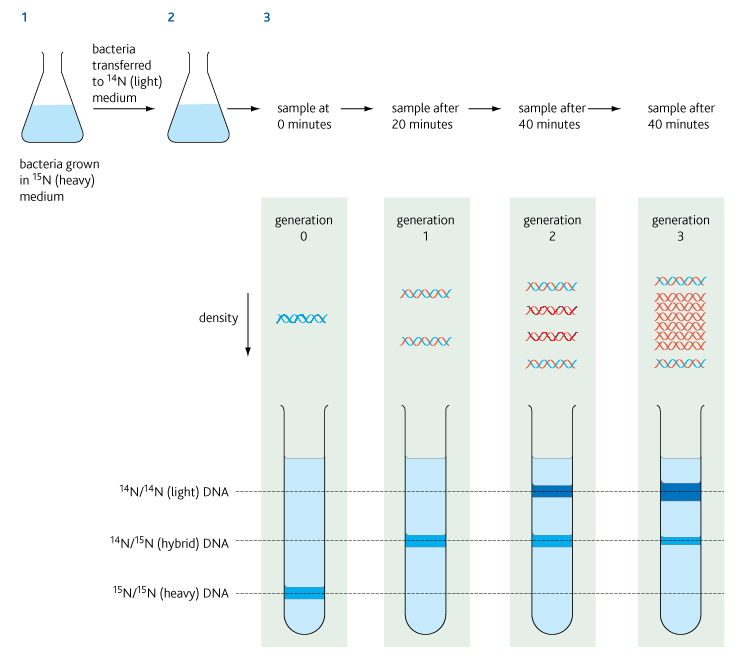
Mesohlsohn Stahl used escherichia coli (E.coli) with heavy nitrogen isotope 15N.

This is to label all DNA with heavy nitrogen isotope 15N.

Bacteria with 15N transferred into medium containing normal isotope 14N .

Sample were removed at fix interval corresponding to the generation time of E.coli at a specific temperature.

DNA from different generations were extracted N-centrifuged in a solution containing CsCl to separate denser DNA containing 15N from lower DNA containing 14N.

Position of DNA with 15N and DNA with 14N was measured with uv light.

In generation zero, all DNA containing 15N on both strand of double helix forming a dark band near the base of centrifuge.

In generation one, all DNA 15N on one strand and 14N in another strand, forming a band btw heavy & light band.

in generation two, half of DNA were hybrid.another half were light DNA with 14N.

in generation 3, DNA with 14N three times thicker than 15N and number of hybrid DNA remain the same.

For the result of 1st generation ,it eliminates the conservative hypothesis not explain presence of hybrid DNA.

For the result of second generation, it eliminates dispersive hypothesis because the hypothesis not explaining the presence of light DNA in second generation.

Beadle & Tatom's experiment

Neurospora can grow in minimal medium if it is not mutated


they can synthesise the enzyme which is needed to produce amino acids


Beadle and Tatum had grow Neurospora in minimal culture


Then, they exposed the Neurospora with X-ray caused mutation in Neurospora


They found that mutated Neurospora unable to grow in minimal medium because gene that codes for the synthesis of enzyme used to produce certain amino acid is mutated


The mutated neurospora only grew in complete culture which contain all 20 amino acid


Thus  they isolate the mutated neurospora and grew them in minimal medium with a type of amino acid


Altogether there are 20 minimal medium with 20 different amino acid each


They found that neuropspora can only grew in presence of particular amino acid which is arginine


They had made one gene one enzyme hypothesis means the gene that code for the synthesis of enzyme that required to make arginine is mutated


One gene one enzyme hypothesis is then modified to one gene one protein hypothesis as the gene coiled code for other protein not necessary arginine


When it is found out that a protein can consist of more than one polypeptide chain


The hypothesis is further refined to one gene one polypeptide hypothesis


diagram a


Sulphur cycle

Volcanoic eruption or industrial activities spill out sulphur dioxide gas (SO) into atmosphere.

Rain brings it down forming acid rain.

Sulphate (SO42-) dissolve in soil and absorbed by plants for synthesis of protein.

Sulphate is reduced to organic R-SH group which used by plants to synthesis amino acid systeine , protein & coenzyme A.

The sulphur containing organic compounds are passed to herbivores when they eat plants.

The sulphur is transferred to carnivores along the foood chain.

When the animal and plants die , decomposed aerobically back to form sulphate.

Sulphur containing organic compounds in the organism may be anaerobically converted to hydogen sulphide (
H2S )

Sulphate in soil will change into H2S by Desulphovibrio (sulphate reducing bacteria)

H2S are converted in the hotspring into sulphur by bacteria Chromatin or Chlorobium.

Sulphur then oxidised by bacteria to form Sulphate back to the soil.


Phosphorus cycle

The major reservoir of phosphorus is rock.

In the rock phosphorus is bound to oxygen to form phosphate.

As water flows over rocks containing phosphorus(river water flows through) it erodes the surface and carries inorganic phosphate into the soil to be taken up by plants.

In plant cells, the phosphate is incorporated into biological molecules like phospholipids , protein and nucleic acid.

When animal feeds on the plant, phosphorus is transferred.

Phosphorus move along the food web as organism consume it and excretion of phosphorus also occur.

Decomposers will decompose waste and dead organisms ; release inorganic phosphate into the soil and water bodies.

Phosphorus released is used by terresterial and aquatic producers.

Phosphorus enter aquatic system as dissolved phosphate which is absorbed by algae and aquatic plants.

The algae and aquatic plants are then consumed by zooplanktons and inturn by fishes.

Some phosphate in the aquatic system returns to lamd via fish and invertebrates eaten by birds.

The faeces of bird contain phosphate which will absorbed by land plants.

Some phosphate can be carried by rivers into the ocean and remain in the seabed for millions of years.

In time, geological uplifting may expose these sediments and reenter the phosphorus cycle.

Phosphorus also enter the water ecosystem artificially through fertilisers.

Leaching of phosphate from agriculture areas increases the phosphate in aquatic habitats and stimulates algal growth.

The completion of phosphorus cycle is very slow because abiotic storage of phosphorus is in the form of rock.

Thursday, December 13, 2018

Selection

Selection  

  1. a process whereby one or more factors acting on phenotypes favour the transmission of particular alleles to the following generation
  2. process whereby organisms which are better adapted to their environment survive and reproduce, while those less adapted fail and usually die
  3. two types of selection ~ natural selection ~artificial selection


Natural selection

process by which individual organism with favourable traits are more likely to survive and reproduce than those unfavourable traits

process brings about evolution and adaptation(enable population to change and adapt to different chromosomes)

results in more favoured traits and less unfavoured traits

  • individuals with beneficial traits are more likely to be selected that is to have more offspring
  • those traits have a heritable component, tend to become more common in next generation
  • alleles with an average result in greater fitness will become more abundant in the next generation
Natural selection does not acts directly on genotype but acts on phenotype

result in evolutionary change

there are many types of natural selection found in population

  • stabilising
  • disruptive
  • directional
  • sexual
  • polymorphism
Artificial selection

  1. process of intensional or unintensional modification of a species through human action which encourages the breeding of certain traits over others. (Breeder selects the desired characteristics)
  2. genotype is altered to produce a new strain of the organism for specific purpose.
Human preferences or influences have a significant effect of the evolution of particular population or species

include outbreeding and inbreeding

eg. domestication of corn & domesticated chicken

*click the link for more info(will be updated soon)


▶Excel in your interview◀ TOP 20 QUESTIONS YOU SHOUL PREPARE BEFORE YOUR INTERVIEW

 Tell me about yourself What is your greatest strength? What is your greatest weakness? Why we should hire you? Why do you want to work here...